SHAKTI VAHINI TO REACH 4000 BORDER VILLAGES IN WEST BENGAL FOR CAMPAIGN AGAINST HUMAN TRAFFICKING
SHAKTI VAHINI
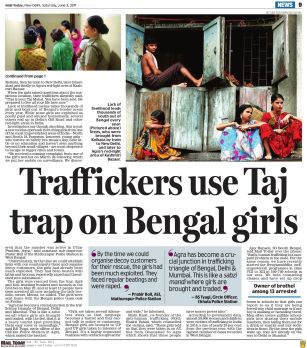
REACHING OUT TO THE COMMUNITY in WEST BENGAL ON HUMAN TRAFFICKING. IN THE NEXT FOUR MONTHS 5 TEAMS OF SHAKTI VAHINI WILL REACH OUT TO 4000 BORDER VILLAGES ACROSS WEST BENGAL
‘Aunts’ stake claim to trafficked girl
NEW DELHI: One of the two young women rescued from Delhi’s hellhole—the infamous GB Road on Friday—could never had never imagined her traffickers going such lengths to try and push her back into flesh trade. Two women, who appeared before the local court where she was produced on Saturday, claimed they were her aunts but could provide no document to prove it. They even refused to state how her parents lost their lives, a claim they made before the court. Cops believe the two are part of the trafficking gang but managed to slip away from the court premises before they could be detained. Police, though, said there was no evidence against the two women to take any action against them.
Shakti Vahini, the NGO that helped rescue her, claimed she is a minor. However, the victim has told Kamla Market police that she is 19 years old and hence a major. This is the reason she was initially not produced before a juvenile justice board. Police claim she’s from Nepal. The local court has now given a detailed order in the case. “Two women, Sarita and Bakula, have appeared and submitted they are the mausi and bua of the girl, respectively. However, they could not provide the names of her parents or how their deaths occurred though they claimed they had passed away. It is doubtful if the women are related to her at all,” metropolitan magistrate Sachin Sangwan said.
The order goes on to state that the cops must get the ossification test of the girl done as there is no document to show that she is a minor.
The other victim, an 18-year-old student from South 24-Parganas, is not happy that Delhi Police has decided to leave it to police in West Bengal to register a case and conduct investigations even after she named five persons. “I request the chairperson to take immediate action against the traffickers and brothel keepers so that many like me can be saved,” she wrote to National Commission for Women.
Trafficked, confined and raped in the heart of Delhi
As Delhi debated and discussed the issue of women’s rights and safety during the past three months, barely four kilometres from Parliament, the seat of Indian democracy, a 19-year-old girl was kept confined within a small cavity in the walls of a brothel at G.B. Road. During this period she was continuously raped – usually by over a dozen men from morning to night.
But even after she was rescued on Thursday, the Delhi Police did not deem it fit to register a gang-rape case. Rather, it even allowed her rapists, abductors and brothel owners to intimidate her during her court presence. And while her father has come from South 24 Parganas district of West Bengal to take his youngest daughter back, she was on Friday sent to Nari Niketan instead.
The tragic tale began this February when the girl was preparing for her Class X Board exams.
Based on the limited conversation that he had with his sister post her rescue, the girl’s brother, who accompanied his father to Delhi, told The Hindu that one evening when she came out of her village house in West Bengal, a drug-laced cloth was pressed against her face which made her unconscious.
“When she came back to her senses, she found herself at the Howrah railway station accompanied by the abductor and few others who told her that they were waiting for a train to Delhi. As she protested, they made her consume some more sedatives and she then regained consciousness only on reaching Delhi,” said Imran (name changed), whose earlier visit to Kotla Mubarakpur and other colonies of Delhi in search of his youngest sister was reported by The Hindu.
Back then, the girl’s brother had contacted NGO Shakti Vahini seeking help.
The same NGO along with the police conducted a raid at the brothel on May 9 and rescued the girl who was found confined in a “cave-like structure” cut into one of the walls.
But the girl’s trauma did not end there. When she was produced before a Duty Magistrate on Friday, the brothel owners were also present in the court room in strength and during the course of hearing, they even showed the gumption to coerce and threaten the girl sitting in the court room to bring her back into the business.
The girl’s father, a man with a white beard, was ready with all the related papers to take his daughter in his custody, but the court said he could get his daughter back only from a regular court.
The girl was then sent to Nari Niketan on technical grounds.
‘Victim of an organised racket’
According to Rishi Kant of NGO Shakti Vahini that helped in the girl’s rescue, she was a victim of an organised racket. The gang members abduct teenaged girls and push them into the flesh trade.
The racket involving Delhi’s brothel owners and traffickers in the hinterland functions so professionally that girls are kidnapped and forced into the trade without being detected because the police response is lukewarm to this crime against women.
An example of this apathy is the three-month delay that was witnessed in registering the missing report by the West Bengal Police into the disappearance of the girl.
The State police only fulfilled this mandatory formality after she was rescued here on May 9.
Dad’s 3-month search for lost daughter ends in city brothel
AMBIKA PANDIT IN THE TIMES OF INDIA
NEW DELHI: In the chaos of busy Swami Shradhanand Marg, commonly referred to as GB Road and known as the capital’s largest red light area, a father wept inconsolably as he hugged his 18-year-old daughter rescued from a hidden chamber in the wall inside a filthy brothel on Thursday.
A Class X student aspiring to be a nurse, the girl was kidnapped from outside her house in a village in the South 24-Parganas district of West Bengal in February this year. She was trafficked to Delhi but police in her home district only registered an FIR in the case on Friday even though the matter was reported by the family on February 15. It was dumped as a mere diary entry of a “missing complaint”.
Even in Delhi all of Friday was spent in deciding whether an FIR should be registered here or not. Finally Delhi Police decided to leave it to the police in West Bengal to register a case and carry out investigations.
This case brings to the fore the plight of the families of missing children. The victim’s father, who is a daily-wage labourer, reveals that the girl was studying for her Class X exam in March. A committed student, the victim stepped out of the house for a short break from her studies and never returned. Her parents and two elder brothers searched in vain and their complaint to the local police failed to make an impact as the records show no effort was made to register a case by police.
Not one to give up hope, the victim’s father contacted NGO Shakti Vahini which had rehabilitated another girl who was trafficked from their village. “I thought maybe someone has taken away my daughter to Delhi like the other girl,” the father told TOI. Some time during the next three months, the father said, an unknown person contacted him to inform she had been kidnapped and kept in a brothel at G B Road. The family was told she was desperate to return home.
The victim’s family joined forces with activists from NGO Shakti Vahini to launch a rescue operation through Delhi Police. The victim’s brother who makes a living by doing embroidery revealed how they went up the narrow stairs to the dingy brothel and finally pulled her out from a hidden chamber. Another girl from Nepal was rescued from a similar chamber in the wall. The victim’s brothers now want to take her home to her mother who has been sick since her disappeared. But the family reunion will have to wait till early next week as the trial court sent her to Nari Niketan for care till final orders are issued for her rehabilitation.
Girl sold, raped and rescued
The long journey of Debyani (name changed) from her village in the Burdwan district of West Bengal to Delhi and then to Bharatpur in Rajasthan is a saga of a minor girl who was kidnapped by traffickers and sold off for forced marriage and then subjected to continuous physical and sexual abuse for the past four years. The girl, who has now been rescued, is the mother of two children.
On the pretext of getting her employed as a domestic help, a fellow villager had one day taken Debyani along to a place where she was handed over to a trafficker four years ago. It was two years after she went missing that the local police registered a specific case on the basis of a complaint lodged by her father who raised suspicion about the complicity of a girl named Sulekha.Police investigations revealed that she was handed over to a person named Kalu Sheikh, who sold her off for a paltry sum. She was then forcibly married to a resident of Deeg village of Bharatpur in Rajasthan. “About a year ago, the investigating officer tracked her down and rescued her. He also arrested Kalu Sheikh. The girl had by then become the mother of two children. Surprisingly, she was escorted back to West Bengal by some villagers. In her judicial statement, she claimed that she had fled on her own as her parents wanted to push her into prostitution. As a result, the accused was released on bail and the girl was taken back to Rajasthan,” said a West Bengal police officer.
It was after the victim’s family moved habeas-corpus petition in the High Court that an Anti-Human Trafficking Unit team led by Inspector Sarbari Bhattacharya was directed to probe the matter. The officer discovered that the case had been closed. She got it reopened and in coordination with non-government organisation Shakti Vahini reached Bharatpur.
“The moment the girl saw the Bengali-speaking woman officer, she clung onto her pleading to take her back home. She even forgot to take her elder son along and wanted to leave immediately. She kept crying, alleging that she was sold off and subjected to torture,” said Rishi Kant, who was part of the rescue team.The police officer made enquiries and found that a woman named Rakhi from West Bengal, who had settled down there 20 years ago, lived in the neighbourhood. “During questioning, she disclosed that she had bought the victim from her relative Kalu Sheikh. Her brother had tortured the victim so much that she still dreads him.”
Realising that it was purely a case of human trafficking, the officer decided to rescue the girl along with her two children and arrested Rakhi. “However, it will be difficult for us to now track down Kalu Sheikh and Sulekha…there are umpteen number of cases were girls and women from West Bengal are being trafficked to places like Delhi and being pushed into prostitution, forced labour and marriage. But we come across officers who do not realise the gravity of the problem and treat the victims as just ‘poor Bengalis’,” said a West Bengal Police officer.
Related articles
- Trafficking of tribal girls: Sick gardens trigger exodus (traffickingnews.wordpress.com)
Trafficking of tribal girls: Sick gardens trigger exodus
SUMATI YENGKHOM IN THE TIMES OF INDIA
Several Delhi-based placement agencies, that claim to provide work to these trafficked girls, are being run illegally and without any registration. These agencies work in nexus with the ‘agents’ who are local tea garden workers and known to the victims.
The ignorant poor parents, who cannot feed their children, are ready to lap up the opportunity of sending the children to Delhi for work. in order to get rid of the their responsibility and also in the hope of getting a regular monthly income.
Once the victims reach Delhi, they stay in touch with the families for a few days. some of them is in contact with the family. But soon they are barred from communicating with their parents and also, money stops reaching their families. Only a handful of them get work as domestic help, while the rest are either sold in brothels or for marriage.
About four months ago, a placement firm by the name Sai Placement Agency lured four girls from the Mateli police station area. Shakti Vahini members rescued the girls with the help of West Bengal Police. The agency was found to be fake and the trafficker Neelima Sharma was arrested after an FIR (number 223/12 under section 363/366/374 dated 21/11.2012) was lodged with the Mateli police.
Though the trend of migration by tribal girls started way back in 2000, the exodus has taken a massive proportion in last five to six years after several tea gardens were declared sick. Many of these tea estates do not even have primary schools and heathcare facilities. There is hardly any penetration by organizations that work for the welfare of the tribals.
Jalpaiguri police are aware of the magnitude of the problem and admitted that there is need to do much more to prevent trafficking. Police’s anti-trafficking activities like awareness programmes are restricted to educational institutions, a place that is out of bounds to the girls here.
“Poverty is the main issue. Unless it is addressed, the girls here will remain vulnerable. Though we cannot do much on that front, we are working on other preventive measures. Few days back we arrested two agents in Banarhat for trying to lure some girls. We need to penetrate deeper into the tea gardens. Officers-in-charge of all police stations have been asked to maintain records of girls who are going away for work, the persons taking them away, contacts of employers in collaboration with the local panchayats,” said Jalpaiguri SP Amit P Javalgi.
The schemes for the poor, like the BPL card and old age pension, are distant dreams. Most are not even aware of the existence of such schemes. There is no effort worth mentioning on part of local politicians for uplift the economic status of this tribal population. A major portion of the funds under schemes like NREGA are being pocketed by local panchayats.
“Recently we found misappropriation of NREGA funds by the local panchayat. Many garden workers were made to sign that they were paid for 100 days work, whereas these illiterate workers were paid only for seven days. We were even threatened by some panchayat members for unearthing this information and educating workers on their rights and dues,” said Omega Minj, a field worker.
Unfortunately NGOs active in anti-trafficking in many pockets of North Bengal seem to have left out these tea gardens of Jalpaiguri.
“We have been working in various parts of North Bengal but we need better penetration in the tea gardens. We will work out with the district administration, police and other stake holders to start off,” said Rishi Kant of Shakti Vahini, an orgnisation that has successfully worked with administration and police in Malda.
Going all guns out on the traffickers by the police could only serve a temporary purpose. Till the concerned departments salvage the tea garden community out of poverty and hunger, young women and children will continue to be smuggled unabated from the cursed tea gardens.
Two minor girls rescued from brothel in Capital
They were kept confined under claustrophobic conditions in an unventilated chamber inside a G. B. Road brothel here to evade detection. Until they were rescued by a joint team this week, the two minor girls were subjected to continuous sexual abuse and physical torture by the woman brothel owner and her men. One of the girls is seven weeks pregnant.
Members of the rescue team now suspect that bogus voter identity cards are being used by flesh traders to portray minor victims as consenting adults.
It was on the basis of a tip-off about some minor girls forced into the flesh trade that a team comprising officials from the Central Bureau of Investigation and the Delhi Police besides representatives of non-government organisation Shakti Vahini was constituted to conduct the rescue operation.
“There were numerous cubicles on the first floor. While looking for the girls in the cubicles we noticed that a wooden plank had been affixed to the wall in one of them. As we removed the plank, it led us into a narrow tunnel wide enough only for a single person. We found two girls inside it. The tunnel had no ventilation,” said a team member.
The team member said both the girls looked traumatised. Once out of the brothel, the victims were offered some eatables and then counselled by experts. They were then produced before the Child Welfare Committee.
One of them disclosed that she belonged to 24 Parganas in West Bengal and was trafficked into the Capital by an unknown person and sold to the brothel keeper for Rs.1.5 lakh.
The victim said she was in love with a village boy, but her family members was against the relationship and even beat her up. About eight months ago, the girl fled from her home and reached a railway station where she met a boy who took her to a place, kept her in confinement and raped her.
She was then raped by the boy’s friend.
She was then brought to the Capital and sold off to the brothel keeper. The girl once tried to flee, at which she was beaten up badly. She told the CWC that she was forced to entertain nearly two dozen persons every day.
“Her medical examination revealed that she is seven weeks’ pregnant. When she was brought before the CWC, a woman approached the Committee and produced a voter identity card claiming that she was an adult. However, it appeared to be a fake document. The CWC has ordered investigations into its authenticity.
In case the identity card turns out to be bogus, we suspect that a similar modus operandi is being used by the flesh traders in G.B. Road to evade law,” said Rishi Kant of Shakti Vahini.
The other victim, a Nepalese national, was brought to the city by her brother-in-law about five months ago and kept at a hotel for a few days before being sold off to the brothel keeper for Rs.3 lakh. “She disclosed that her elder sister died a few years ago. Her brother-in-law who lives in the same village had brought her to Delhi on the pretext of getting her a job in Saudi Arabia. She was beaten up by the brothel keeper whenever she refused to entertain clients,” said Mr. Kant, adding that both the girls were medically examined at JPN Hospital.
Abducted Gurgaon minor rescued from West Bengal
First case of reverse trafficking from Haryana to Bengal
A 13-year-old girl who was allegedly abducted from a village here earlier this month has been rescued from Malda in West Bengal. She was rescued by the local police following a tip-off by a non-government organisation, Shakti Vahini.
The girl’s family had lodged a complaint with the police on January 13 stating that she had been abducted by their neighbour, a native of Malda in West Bengal. The complaint said the accused had abducted her on the pretext of marrying her. A First Information Report was registered at Kherki Dhaula police station in this connection.
The NGO took up the matter with the police and also met the victim’s family.
“We then contacted the Malda Police and the girl was rescued from the Habibpur police station area. During counselling the victim revealed that the accused took her along on the pretext of marriage. It is a clear case of human trafficking and the accused probably wanted to sell her,” said Shakti Vahini activist Rishi Kant. The accused has been arrested.
Mr. Kant, who has been working on the issue of human trafficking in Haryana, said it was the first such case of reverse trafficking in which a girl from Haryana was trafficked to West Bengal.
“Every year a large number of girls are being trafficked from West Bengal to Haryana, but this present case is the first instance where the opposite has happened. It could be the tip of an iceberg and hints at the possibility of a reverse trend. In 2011, more than a thousand minors and 2,677 adults had gone missing in Haryana. There is need for strengthening inter-State police and non-government organisations’ partnership to combat human trafficking in the State.”
Child trafficking continues to be a lucrative trade in Capital
FAIZAN HAIDER IN THE HINDUSTAN TIMES
Around this time in 2012, the issue of child trafficking was in limelight due to the case of the battered child and her 14-year-old ‘guardian’. The teen was treated as a victim when it came to light that she was raped and her father used to beat her up. A year on, various gangs continue to smuggle in young girls to the Capital and force them to work for various placement agencies. “The case was an eye-opener. The chain of events that had led to the incident was shocking. Along with the 14-year-old girl, the mother of the baby too was a victim of trafficking,” a child right activist said.
Following the incident, the Delhi Police launched a massive crackdown on placement agencies and trafficking gangs. Over 1,000 children were rescued in 2012 and action was taken against more than 150 placement agencies. The rescued children were usually employed as workers in factories or as domestic helps in homes.
“On an average, 14 children go missing in Delhi every day. Many of them end up in traffickers’ hands. Children below eight years are forced into begging. The older ones are pushed into child labour. Organised gangs kidnap minors and transport them to other cities,” said Rakesh Senger, national secretary of Bachpan Bachao Andolan, an NGO.
Sources in Delhi Police said special measures were being taken to curb the problem. “We have identified the areas from where children go missing. We will soon launch an awareness programme to educate parents about safeguarding their children. We take missing persons’ complaints very seriously now,” said a senior police officer.
Rishikant, executive director of NGO Shakti Vahini, said strict laws against trafficking could act as a deterrent.
Special cell to deal with inter-state trafficking cases
NEELAM PANDEY IN THE HINDUSTAN TIMES
A year after the death of the two-year-old battered baby at AIIMS last year, the Delhi government has constituted a centralised cell to deal inter-state cases of trafficking. The government is making efforts to chart out steps needed to deal with trafficking, especially of girls who are later exploited sexually. The state women and child department has appointed a consultant to come up with a list of initiatives and steps required to keep a check on trafficking. The consultant stressed the need to provide intensive counseling to rescued children so that they can lead a normal life.
“There is a lack of coordination between states on the trafficking front. A number of children are trafficked to Delhi and repatriating them is our biggest concern. We needed a systematic approach to deal with the situation and so decided to form a centralised cell. It will coordinate with states such as West Bengal, Chhattisgarh, Bihar, Jharkhand and other states from where children are mostly brought to Delhi,” said Kiran Walia, women and child development minister.
Most trafficked children are either forced into prostitution or employed by placement agencies. The women and child development department has now taken up the matter with the labour ministry to bring in a bill to rein in placement agencies. The department wants these agencies to be registered to ensure that the government can keep a check on them as many flout labour norms.
In the past few months, child welfare committees have rescued 197 children and repatriated them with the help of Delhi Police. The government now plans to tie up with various NGOs such as Shakti Vahini, who work for such children, to carry out rescue operations on a larger scale.
The issue of trafficking has been taken up with other states from where a majority of the children are trafficked to Delhi. These states have been asked to share details on a regular basis of children who go missing.


leave a comment